You want reliable grub control that actually protects your lawn, so start with proven granules like imidacloprid-based Grubs Away or Merit for systemic, BioAdvanced for season-long protection and quick‑action 24‑Hour blends, Delta Gard for large areas, Hi‑Yield and Bonide for budget season‑long coverage, and Milky Spore if you prefer a biological option for Japanese beetle larvae; apply at recommended timing (pre‑hatch or at first signs), water in, follow spreader settings, and keep an eye on results—now check the full guide to learn which fits your yard best.
Some Key Points
- Choose products with imidacloprid or clothianidin for season‑long systemic grub control and reliable turf protection.
- For fast knockdown and broader insect control, use granular formulas containing bifenthrin or cyfluthrin.
- Select coverage size (5,000–10,000 sq ft) to match your lawn to avoid under- or over‑application.
- Consider biological options like Milky Spore for eco-friendly, long‑term Japanese beetle grub suppression.
- Time application properly: apply pre‑hatch in late summer/early fall or at first grub signs for best results.
Grubs Away Imidacloprid 0.5G Insect Control, 9 Pounds
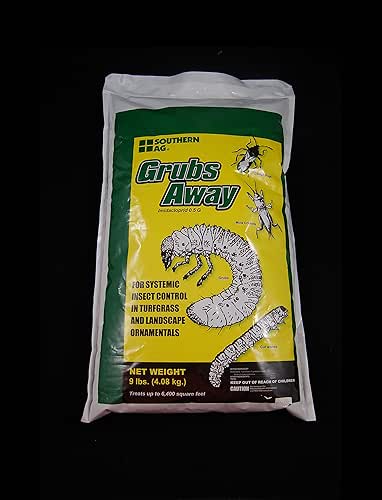
If you’ve got a mid-sized lawn and you’re serious about stopping grub damage before it gets out of hand, Grubs Away Imidacloprid 0.5G in the 9‑pound bag is a smart choice because it’s a systemic granular insecticide that treats up to 6,400 square feet, so you won’t be running back to the store mid-season. You’ll spread it evenly, water it in so the active ingredient imidacloprid moves into the root zone, and you’ll target grubs and mole crickets effectively; now monitor turf health, repeat per label timing if necessary, and expect fewer grub hotspots within weeks.
Best For: Homeowners with mid-sized lawns (up to ~6,400 sq ft) who want a systemic granular treatment to prevent and control grubs and mole crickets.
Pros:
- Systemic imidacloprid granules provide effective control of grubs and mole crickets when watered into the root zone.
- 9-pound bag covers up to about 6,400 sq ft, reducing the need for frequent repurchases.
- Highly rated by customers (4.8/5), suggesting good real-world performance.
Cons:
- Contains imidacloprid, a neonicotinoid with environmental concerns for pollinators and non-target insects if misused.
- Requires proper application and watering-in to be effective; misuse can reduce efficacy and increase risk.
- Not suitable for very large lawns beyond the stated coverage without purchasing additional product.
BioAdvanced Season Long Grub Control Plus Turf Revitalizer, Granules, 12 LB
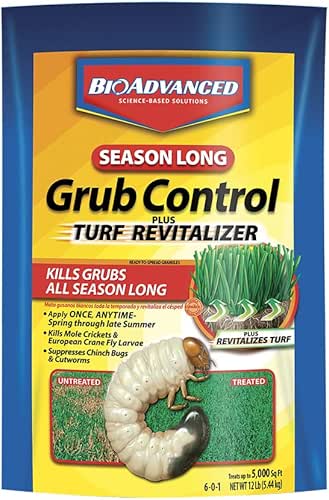
For a homeowner who wants one reliable, low-fuss product to both stop grubs and strengthen your lawn, BioAdvanced Season Long Grub Control Plus Turf Revitalizer, Granules, 12 lb is a smart choice — think of it as a two-in-one lawn rescue that saves you time and worry. You’ll treat up to 5,000 square feet with ready-to-spread granules that work immediately and protect throughout the season, now this is where you act: apply at the first sign of grubs. The formula also targets mole crickets, crane fly larvae, and billbugs, and the key is consistent application with a rotary or drop spreader.
Best For: Homeowners who want a single, low-fuss granular product to kill grubs and other turf pests while strengthening roots and covering up to 5,000 sq ft.
Pros:
- Kills grubs plus targets mole crickets, European crane fly larvae, and billbugs.
- Ready-to-spread granules for easy application with a rotary or drop spreader.
- Starts working immediately and provides season-long protection for treated lawns.
Cons:
- Must be applied at the first sign of grubs for best results, so timing is important.
- Single 12 lb bag only covers up to 5,000 sq ft, may need multiple bags for larger lawns.
- Granular application can be uneven without proper spreader calibration, risking over- or under-treatment.
Delta Gard Granules 20 lb Bag

When you need broad, reliable control over common lawn invaders, the 20 lb Delta Gard Granules from Bayer are a strong pick, especially if you’re treating up to 10,000 square feet and want a product that works across lawns, perimeters, and even individual ant mounds. You’ll broadcast 2–3 pounds per 1,000 sq ft with a spreader, or apply a teaspoon around fire ant mounds, then lightly water a gallon to dissolve granules for better uptake. This targets cockroaches, chinch bugs, and other turf pests; now monitor results, reapply as label directs, and keep equipment calibrated for consistent coverage.
Best For: homeowners and groundskeepers needing a granular, long‑lasting treatment for lawns and perimeters up to 10,000 sq ft to control fire ants, chinch bugs, cockroaches, and other turf pests.
Pros:
- Covers up to 10,000 sq ft per 20 lb bag when applied at 2–3 lb per 1,000 sq ft, making it economical for large areas.
- Versatile application options: broadcast, perimeter barrier, and direct mound treatment (with light watering to activate).
- High customer rating (4.7/5 from 328 reviews) from a reputable brand (Bayer).
Cons:
- Requires careful calibration of spreaders and adherence to label rates to avoid over- or under-application.
- Product details list conflicting or confusing package specs (e.g., item weight 0.01 oz, liquid volume 1 gallon) that may be misleading.
- Chemical treatment may not be suitable for organic lawns, pets, or areas with pesticide restrictions without following safety precautions and label instructions.
BioAdvanced 24-Hour Grub Killer Plus Granules (10 lb)
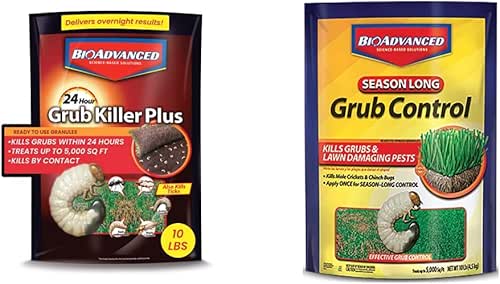
Gardeners who want fast, reliable grub control will find BioAdvanced 24-Hour Grub Killer Plus Granules (10 lb) a smart choice, especially if you’re dealing with signs of lawn stress like brown patches or digging from animals that feed on grubs. You’ll apply granules at the first sign, and the formula starts working within 24 hours to kill grubs and many surface and soil insects, creating a barrier for season-long protection. Now, spread evenly over affected areas, water lightly to activate the product, and monitor results; the improved formula handles ants, ticks, chinch bugs, cutworms, and more.
Best For: Gardeners and homeowners who need fast-acting grub and lawn insect control to quickly stop turf damage and provide season-long protection.
Pros:
- Kills grubs within 24 hours and begins working quickly against a wide range of surface and soil insects.
- Provides season-long protection by creating a barrier when applied and watered in.
- Ready-to-spread granules are easy to apply over affected areas and larger lawns.
Cons:
- Requires prompt identification and application at first signs of grubs to be most effective.
- May harm non-target insects; caution needed when applying near pollinator-attractive plants.
- Lawn watering and proper application are needed to activate and maintain effectiveness.
VPG Hi-Yield Grub Free Zone III – 10 lb. Bag
If you’re facing grub or mole cricket damage and want a straightforward, reliable fix, VPG Hi-Yield Grub Free Zone III — the 10 lb. bag — is a top pick for homeowners with medium to large lawns who need season-long protection; it targets white grubs, chafers, Japanese beetles, Asiatic garden beetles, and oriental beetles, so you’re covering the usual suspects in one go. You’ll spread granules before hatching, now that timing is key, and the formula acts on newly hatched insects, killing grubs and mole crickets quickly; follow label rates, water it in, and expect visible turf recovery within weeks.
Best For: Homeowners with medium to large lawns seeking season-long protection against grubs and mole crickets who can apply granules at the proper pre-hatch timing and follow label instructions.
Pros:
- Targets a wide range of turf pests (white grubs, chafers, Japanese beetle, Asiatic garden beetle, oriental beetle).
- Season-long protection when applied correctly and watered in.
- Fast-acting on newly hatched grubs and mole crickets, helping turf recover within weeks.
Cons:
- Must be applied before hatch for optimal effectiveness, so timing is critical.
- Requires proper application and watering-in to work; misuse can reduce effectiveness.
- Not a targeted solution for non-grub pests or treatment after heavy established infestation.
Andersons DuoCide Professional Lawn Insect Control (18 lb)
For a homeowner who wants professional-strength results without hiring a pro, the Andersons DuoCide Professional-Grade Lawn Insect Control (18 lb) is a smart pick, especially if you’ve got a big yard—one bag treats up to 9,000 square feet and delivers a double kill above and below the turf. You’ll apply the DG granules, water them in, and watch the formula move into the soil, where bifenthrin and carbaryl target grubs, ticks, fire ants, mole crickets, and fleas. Now, follow label directions closely, monitor results, and reapply only as recommended to stay effective and safe.
Best For: Homeowners with large yards who want professional-strength, broad-spectrum control of lawn pests (grubs, ticks, fire ants, mole crickets, fleas) without hiring a pro.
Pros:
- Covers up to 9,000 sq ft with a single 18 lb bag, so one purchase treats a large lawn.
- DG granules disperse quickly and move active ingredients into the soil for above- and below-surface control.
- Contains professional-grade bifenthrin and carbaryl for effective control of 50+ common lawn pests.
Cons:
- Contains strong professional insecticides (bifenthrin and carbaryl) that require strict adherence to label directions and safety precautions.
- Not for sale in California, limiting availability for residents there.
- Chemical control may harm non-target organisms (pollinators, beneficial insects) if misapplied.
Bayer – Merit 0.5 Granular Systemic Insect Control – 30 Pound Bag
Think of the Merit 0.5 granular system as your go-to professional tool when you need reliable, systemic insect control across larger lawns and landscapes, because it’s formulated with 0.5% imidacloprid to protect turfgrasses, trees, shrubs, evergreens, flowers, and ground covers from soil- and foliage-feeding pests. You’ll apply the 30-pound bag across affected areas, now follow label rates carefully, because the limit is 80 lb per acre per year and an active ingredient cap of 0.4 lb per acre per year. The key is even coverage, timely watering to activate systemic uptake, and checking directions for safety and targeted timing.
Best For: Landscapers and homeowners managing large lawns and mixed landscapes who need reliable systemic control of soil- and foliage-feeding pests across turf, trees, shrubs, and ornamentals.
Pros:
- Provides long-lasting systemic protection using 0.5% imidacloprid effective for many turf and landscape pests.
- Large 30-lb bag covers extensive areas, suitable for professional or large-property use.
- Versatile for use on turfgrasses, trees, shrubs, evergreens, flowers, foliage plants, and ground covers.
Cons:
- Application restricted to a maximum of 80 lb per acre per year and 0.4 lb active ingredient per acre per year, limiting frequency/amount of use.
- Contains a neonicotinoid (imidacloprid), which may pose risks to pollinators and non-target organisms—requires careful timing and application.
- Requires even coverage and watering to activate systemic uptake; improper use can reduce effectiveness.
Bonide Products 603 Annual Grub Killer, 6-Pound
You’ll want Bonide Products 603 Annual Grub Killer if you’re looking for a straightforward, season-long solution for grub damage on medium to large lawns, because this 6-pound bag treats up to 5,000 square feet and uses imidacloprid, a systemic insecticide that gets into the turf and stops grub feeding quickly. You’ll apply granules between late May and mid-August, now this is where timing matters, the systemic action lasts all season so you don’t retreat often, and the key is even spreading for quick, reliable kills; follow label directions, expect fast results, and monitor turf health afterward.
Best For: Homeowners with medium to large lawns seeking a one-time, season-long granular treatment to prevent and control turf-damaging grubs.
Pros:
- Provides season-long systemic control with a single application when applied late May–mid-August.
- Covers up to 5,000 sq ft per 6 lb bag, making it cost-effective for medium/large yards.
- Fast-acting imidacloprid stops grub feeding quickly and protects turf health.
Cons:
- Contains imidacloprid, a neonicotinoid with potential environmental concerns for pollinators and non-target insects.
- Timing is important; improper application window reduces effectiveness.
- Granular application requires even spreading and following label directions, which may be less convenient than some liquid or professional options.
BioAdvanced Season-Long Grub Control Granules (10 lb)
If you’ve got a medium-to-large lawn where grub damage shows up every summer, the BioAdvanced Season-Long Grub Control Granules (10 lb) is the practical choice that gives you broad, hands-off protection, treating up to 5,000 square feet with ready-to-spread granules that work immediately and keep working all season. You’ll appreciate that it targets 40-plus pests, from ants and ticks to mole crickets and European crane fly larvae, so you can tackle multiple threats at once, now apply with any rotary or drop spreader, and the key is to treat at first grub signs to prevent further turf damage and see season-long results.
Best For: Homeowners with medium-to-large lawns (up to 5,000 sq ft) who want an easy, season-long, hands-off solution to prevent and control grubs and a wide range of lawn pests.
Pros:
- Ready-to-spread granules apply easily with any rotary or drop spreader.
- Starts working immediately and provides season-long protection against 40+ pests (e.g., grubs, ants, ticks, mole crickets).
- Covers up to 5,000 square feet, suitable for medium-to-large lawns.
Cons:
- May not be ideal for very small lawns (product size and coverage may be excessive).
- Requires correct timing at first sign of grubs for best preventative results.
- Contains pesticides, so care is needed around children, pets, and pollinators (follow label precautions).
ST. Gabriel Organics Milky Spore Granular Japanese Beetle Killer
Homeowners who want a low-maintenance, long-term fix for Japanese beetle grubs will find the St. Gabriel Organics Milky Spore Granular Japanese Beetle Killer fits the bill, and you’ll appreciate how simple it is to use. You spread the 20-pound granules with a lawn spreader to treat up to 7,000 square feet, now sit back as milky spore, a natural bacterium, multiplies in the soil and targets only Japanese beetle grubs. This is where patience pays off, because a single application can protect your lawn for years, it’s safe for kids and pets, and it helps grass recover.
Best For: Homeowners with lawns seeking a low-maintenance, long-term, eco-friendly solution specifically for Japanese beetle grubs.
Pros:
- Targets Japanese beetle grubs with a natural bacterium (milky spore) that multiplies in the soil.
- Single 20-lb application covers up to 7,000 sq ft and can provide protection for many years (up to 10+ years).
- Non-toxic and safe for children, pets, and beneficial wildlife, aiding lawn recovery and healthier grass.
Cons:
- Works specifically on Japanese beetle grubs and will not control other grub species or pests.
- Requires patience for the bacterium to establish and reach full effectiveness over time.
- Initial results may be slower compared with chemical grub killers, so immediate grub control is limited.
Factors to Consider When Choosing Grub Control Granules

When you’re choosing grub control granules, the key is to look at the active ingredient type so you know whether you’re targeting beetle larvae with a chemical insecticide or a biological agent like milky spore, and understand what each one actually does. Next, consider the coverage area needed and timing of application—now is when you plan treatments for peak grub activity, and matching granule spread rates and seasonal timing will determine effectiveness. This is where environmental safety considerations and application method compatibility come in, because you’ll want a product that’s safe for pets, pollinators, and soil life, and that works with the spreader or pump you already use.
Active Ingredient Type
Start by focusing on the active ingredient, because this choice largely determines how quickly and how thoroughly grub control granules will work on your lawn, and what trade-offs you’ll need to accept; common chemicals like imidacloprid and bifenthrin act on an insect’s nervous system and tend to deliver relatively fast knockdown — often within a day — while biological options such as Milky Spore use a beneficial bacterium that targets grub larvae more selectively and can provide multi-year control without synthetic pesticides. You’ll want to weigh speed against environmental impact, picking synthetic neurotoxins for quick relief, or a biological like Milky Spore for long-term, eco-friendlier suppression; the key is matching ingredient type and concentration to your tolerance for chemicals, then checking proven reviews.
Coverage Area Needed
Think of coverage area as the single practical metric that tells you how much lawn a bag of granules will actually protect, because matching that number to your yard size prevents wasted product or under-application; start by measuring your lawn so you know whether a product rated for 5,000, 7,500, or 10,000 square feet fits, and don’t guess. Now, the key is checking the label for coverage and application rates, since those determine how much granules you’ll need for effective pest control and can vary by product; a larger coverage area often saves money on bigger lawns, while a mismatch leads to gaps in protection. This is where season-long formulas shine for maintenance, just be sure the stated coverage matches your measured area.
Timing Of Application
You’ve measured your lawn and matched it to a bag’s coverage, now you’ve got to pick the right time to put those granules down so they actually stop grubs before they eat your turf. Timing matters, because most grub control works best before larvae hatch, so you’ll plan applications for early spring or late summer depending on your region, and the key is syncing treatment with the grub life cycle. Now monitor local pest reports and watch for first signs of grubs, this is where season-long products shine by killing quickly and protecting longer—some granules act within 24 hours—so apply at first detection or during peak activity, usually late May through mid-August, to prevent serious damage.
Environmental Safety Considerations
When you’re weighing grub-control options, environmental safety should be front and center, because the product you pick affects more than just beetle larvae—it touches beneficial insects, pets, soil health, and nearby waterways—so focus on choices that give protection without collateral damage. Now look for natural or eco-friendly active ingredients, like Milky Spore, which targets grubs while leaving pollinators and pets safer, and the key is to choose granules with low non-target toxicity so worms, bees, and birds aren’t harmed. This is where biodegradability matters, because granules that break down naturally reduce long-term residue, and long-lasting formulas that need fewer reapplications cut chemical runoff; evaluate environmental labels and pick products that balance efficacy with confirmed minimal impact.
Application Method Compatibility
If you want the granules to do their job without making application harder than it needs to be, start by matching the product to the spreader you’ll use, because not all formulations flow the same and that affects how evenly they land and how well they get into the soil. Now, check whether the label says it’s for rotary or drop spreaders, this is where you avoid clumping and missed spots; the key is consistent flow. Also look for formulations that disperse quickly with water, so active ingredients penetrate the root zone instead of sitting on top. Pay attention to specified application rates, usually 2–3 pounds per 1,000 sq ft, and note timing and frequency recommendations, because they determine real-world effectiveness and coverage.
Some Questions Answered
Can Grub Granules Harm Nearby Beneficial Insects Like Bees and Earthworms?
Yes, grub granules can harm bees and earthworms if you’re not careful, so you’ll want to act deliberately, read labels for active ingredients like imidacloprid or chlorantraniliprole, and avoid treating blooming plants or wet soil where bees forage or worms surface. Now, apply granules to targeted turf only, water them in per instructions to limit dust, and monitor soil activity, this is where choosing reduced-risk products pays off.
How Long After Application Can I Safely Use My Lawn for Kids and Pets?
You can usually let kids and pets back on the lawn 24 to 48 hours after application, once granules have been watered in and the surface’s dry, but always check the product label and local regulations, they’re the legal and safety authority. Now, if you used a stronger or systemic insecticide, this is where extended re-entry times matter, sometimes up to a week; the key is confirming the specific re-entry interval and rinsing paws after play.
Can Granules Be Combined With Fertilizer or Overseeding Treatments?
Yes, you can usually mix grub-control granules with fertilizer or overseeding, but read labels first, because some insecticides shouldn’t be combined; the key is confirming active ingredients and timing. Apply grub granules when soil temps match label guidance, spread fertilizer afterward or choose a compatible product, then overseed a few days later so seed contacts soil. This approach gives pest protection without harming seedlings, and it keeps kids and pets safer.
Do Granular Grub Controls Affect Other Lawn Pests Like Chinch Bugs?
No, granular grub controls usually target beetle larvae and won’t reliably control chinch bugs, which are surface-feeding true bugs; they need insecticides labeled for chinch bugs, or broad-spectrum products containing bifenthrin or cyfluthrin. Now, test your lawn to confirm the pest, this is where a soap flush or turf inspection helps, and then apply the correct product at the labeled rate, timing treatments for peak activity to get observable, lasting control.
Are Granular Products Effective in Cold or Northern Climates?
Yes, granular products can work in cold or northern climates, but timing matters: apply in late summer to early fall before soil chills, because grubs feed near the surface then, and the granules move into root zones with irrigation or thaw. This is where preemptive application pays off, now monitor soil temperature and moisture, and the key is staying ahead of grub life cycles so the insecticide contacts larvae when they’re vulnerable.