You need a simple tool that stops guesswork and keeps roots happy, and these seven meters do just that: XLUX and Gouevn give quick, battery‑free moisture checks, Luster Leaf 1820 adds a plant guide for watering, SONKIR and the 4‑in‑1 models measure moisture plus pH and light for fuller diagnostics, and YAMRON adds temperature with a backlit readout; the key is inserting the probe to root depth, reading promptly, and cleaning the tip—keep going to see which fits your plants.
Some Key Points
- Choose meters with appropriate probe length (5–12 in.) to reach plant root zones for accurate moisture readings.
- Prefer battery-free analog probes for simplicity, or backlit digital meters when you need clearer readings in low light.
- Use multi‑function 3–4‑in‑1 meters when you want pH, light, or nutrient info alongside moisture diagnostics.
- Avoid leaving metal probes in soil longer than recommended and clean tips regularly to maintain accuracy and durability.
- Test multiple spots and follow species-specific watering guides to prevent overwatering or underwatering across containers and beds.
XLUX Soil Moisture Meter Probe 2-Pack
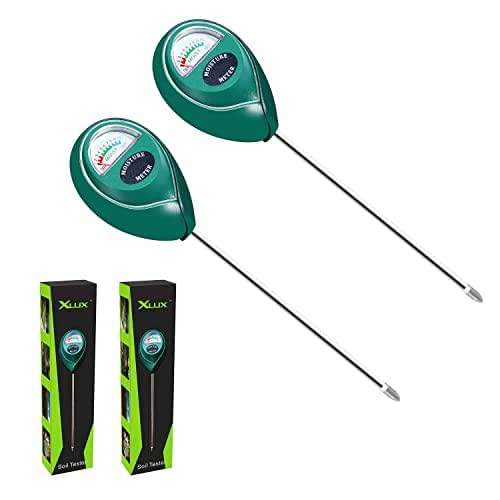
If you want a simple, reliable tool that tells you whether your plants are thirsty without fuss, the XLUX Soil Moisture Meter Probe 2-Pack is a smart pick for home gardeners and small-scale growers; the key is its straightforward analog dial that gives instant, deep-soil moisture readings, so you’ll stop guessing from surface dryness and start watering with confidence. You’ll insert the probe briefly, read the large dial showing three zones and ten scales, then remove and clean it, now avoiding root damage by not leaving it in over five minutes; this no-battery meter keeps care fast, clear, and dependable.
Best For: Home gardeners and small-scale growers who want a quick, no-fuss analog tool to check deep-soil moisture and avoid over- or under-watering.
Pros:
- No batteries required — instant readings with a simple analog dial.
- Deep-soil probe gives more accurate moisture insight than surface checks.
- Large, easy-to-read three-zone dial with ten scales for straightforward interpretation.
Cons:
- Probe must not be left in soil over 5 minutes to avoid corrosion and potential root damage.
- Not suitable for testing very hard soil or liquids.
- Analog meter may be less precise than digital sensors and lacks data logging.
Luster Leaf 1820 Rapitest Soil Moisture Meter

For gardeners who want a simple, no-fuss way to check moisture at the root level, the Luster Leaf 1820 Rapitest Soil Moisture Meter is a practical pick, especially if you’re managing a mix of houseplants, raised beds, or containers and need quick, reliable readings without batteries. You’ll insert the probe, watch the gauge read 1–10, and know if soil is dry, moist, or wet, the key is matching that number to the included plant guide for over 150 species. Now, follow the manual for proper use, avoid non-soil tests, and expect consistent, lightweight performance you can trust.
Best For: Gardeners and plant owners who want a simple, battery-free tool to quickly check root-zone moisture for houseplants, containers, or raised beds.
Pros:
- Instant, battery-free moisture readings on a clear 1–10 gauge for quick decisions.
- Includes watering guidelines for over 150 plant species to simplify care.
- Lightweight and easy to use — just insert the probe and read at root level.
Cons:
- Designed for soil use only; not suitable for testing potting mixes with added amendments or non-soil materials.
- Analog readings can be less precise than digital meters and may require interpretation.
- Probe can be damaged if forced into very rocky or compacted soil; requires careful insertion.
Gouevn Soil Moisture Meter for Plants (No Battery)
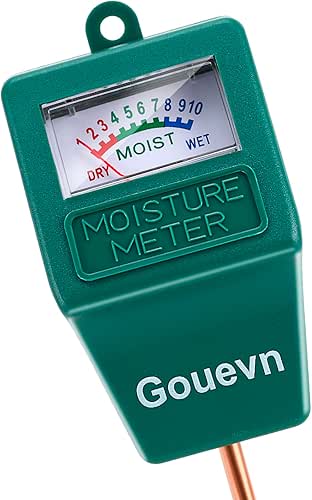
Gardeners who want a simple, no-fuss way to stop guessing when to water will appreciate the Gouevn Soil Moisture Meter, a battery-free tool that gives you quick, reliable readings with a large dial so you can act fast. You’ll insert the lightweight probe into potting mix, lawn soil, or garden beds, read the clear dial that shows moisture levels, and adjust watering immediately, preventing over- or under-watering. The key is to use it only for soil, pull it out after testing to protect the sensor, and avoid very hard ground; the included watering guide helps you interpret readings and care for delicate plants.
Best For: Gardeners and plant owners who want a simple, battery-free way to quickly check soil moisture for potted plants, garden beds, lawns, or delicate specimens.
Pros:
- Simple, no-battery operation with a large, easy-to-read dial for quick moisture readings.
- Lightweight and portable probe that works in potting mix, lawns, and garden soil.
- Includes a watering guide to help interpret readings and avoid over- or under-watering.
Cons:
- Designed only for soil—should not be used in water or other liquids.
- Sensor can be damaged if left in the soil for extended periods.
- Not suitable for testing very hard or compacted soils.
4-in-1 Soil Moisture & pH Meter for Gardening
You’ll appreciate the 4-in-1 Soil Moisture & pH Meter if you want a simple, no-fuss tool that tells you exactly what your soil needs—moisture, light, nutrient level, and pH—so you can water, feed, and place plants with confidence. This upgraded meter diagnoses soil in seconds after you insert the probe at least 2.5 inches, so you’ll get quick guidance on when to water, add fertilizer, or move a plant to brighter light. The 90° rotating head makes readings easy, the single probe minimizes root damage, and no batteries mean it’s always ready; polish the tip periodically to keep it accurate.
Best For: gardeners and plant lovers who want a simple, battery-free tool to quickly check soil moisture, light, nutrient level, and pH for indoor and outdoor plants.
Pros:
- Provides fast, 4-in-1 readings (moisture, light, nutrients, pH) to guide watering, feeding, and placement decisions.
- 90° rotating head and single probe design make readings easy and minimize root damage.
- No batteries required and durable probe—easy to store and use anytime.
Cons:
- Requires inserting probe at least 2.5 inches, which may be difficult in compact pots or rocky soil.
- Accuracy can degrade if probe tip is not regularly cleaned and polished as recommended.
- Not a digital meter—readings are analog and may be less precise than electronic devices.
YAMRON 4-in-1 Soil Moisture, PH, Light & Temp Meter
If you want a single tool that quickly tells you whether a plant needs water, sunlight, or a soil tweak, the YAMRON 4‑in‑1 is a great choice, especially when you’re juggling both indoor pots and outdoor beds. You’ll insert the probe about four inches, wait ten seconds, and get moisture, pH, temperature and light readings on a large backlit LCD, which makes checks easy in dim sheds or bright patios. The key is to pre-moisten hard soil, test several spots for an average, and use the rotating head to read results comfortably, so you’ll stop guessing and start adjusting confidently.
Best For: gardeners and plant owners who want a single, easy-to-use tool to quickly check soil moisture, pH, temperature, and light for both indoor pots and outdoor beds.
Pros:
- Quick 4-in-1 readings (moisture, pH, temperature, light) on a large backlit LCD for use in varied lighting.
- Easy to use: insert probe ~4 inches, wait 10 seconds; rotating head and simple display aid comfortable reading.
- Versatile for indoor and outdoor use; lightweight and portable for spot-checking multiple locations.
Cons:
- Requires 4 AAA batteries (not included), adding ongoing cost and setup steps.
- Probe may need pre-moistening and multiple spot tests for accurate results in hard or dry soils.
- pH and moisture accuracy can be limited compared with laboratory instruments or dedicated single-function meters.
XLUX Soil Moisture Meter Probe (2-Pack)
For anyone who tends larger pots or tests plants both inside and out, the XLUX 2-pack is a smart, no-nonsense choice that keeps things simple and reliable: its 5.5-inch (14 cm) probe reaches down to the bottom of deep containers so you can check root-zone moisture where it really matters, and the large dial instantly tells you whether soil is dry, moist, or wet without squinting or guessing. You’ll insert the single probe, glance at the three-zone dial with ten scales for more nuance, then withdraw within five minutes to avoid tip corrosion; wipe it clean, avoid rocks or standing water, and repeat.
Best For: gardeners and plant owners with large pots or deep containers who need a simple, quick way to check root-zone moisture for indoor or outdoor plants.
Pros:
- Long 5.5-inch (14 cm) probe reaches the bottom of deep pots for accurate root-zone readings.
- Large, easy-to-read dial with three zones and ten scales provides immediate, straightforward moisture info.
- Simple, single-probe design minimizes root disturbance and is easy to use without batteries.
Cons:
- Metal probe can corrode if left in soil for more than five minutes, requiring careful timing and maintenance.
- Not suitable for testing very hard soil or liquids/standing water.
- Provides only qualitative moisture ranges (dry, moist, wet) rather than exact moisture percentage or digital precision.
SONKIR 3-in-1 Soil pH Moisture Light Tester
Gardeners who want a straightforward, no-fuss way to check soil conditions will find the SONKIR 3-in-1 Soil pH Moisture Light Tester a smart pick, especially if you’re balancing indoor pots and outdoor beds and need quick, actionable readings. You’ll flip the function button to measure moisture, pH, or sunlight, insert the probe into moist soil — this is where accuracy matters, since it won’t read liquid pH — and wait a few minutes for the clear readout. No batteries mean it’s always ready, portable for lawns or houseplants, and built to last, so you’ll get reliable, repeatable results fast.
Best For: Gardeners and plant-keepers who want a simple, portable tool to quickly check soil moisture, pH, and light for indoor pots, lawns, and garden beds.
Pros:
- No batteries required — always ready to use and low maintenance.
- 3-in-1 functionality (moisture, pH, light) provides quick, actionable readings with a single device.
- Compact and durable design makes it portable for indoor and outdoor use.
Cons:
- Cannot measure pH of liquids and requires moist soil for accurate pH readings.
- Readings are basic and not as precise as laboratory tests or high-end meters.
- Probe design may be less suitable for very rocky or compacted soils.
Factors to Consider When Choosing Soil Moisture Meters

Now that you’ve seen the SONKIR tester, it’s time to look at the factors that really matter when you buy a soil moisture meter, because the right choice depends on accuracy, probe length, sensor durability, readout visibility, and the broader feature set. Start by checking measurement accuracy and probe length—accuracy tells you how close readings are to real moisture levels, and probe length determines whether you can reach shallow pots or deep garden beds. This is where you weigh sensor durability and screen visibility against extra features like pH or light sensing, so you get a tool that lasts, gives clear readings in bright or low light, and actually solves your watering problems.
Measurement Accuracy
Accurate moisture readings can make the difference between a thriving plant and one that’s slowly stressed, so you’ll want a meter that measures what’s happening below the surface, not just the top inch; this is where probe depth, sensor type, and consistent upkeep come into play. You’ll rely on meters that report moisture on a clear scale, often 1–10, so you can translate numbers into action — water now, wait, or hold off — and the key is choosing sensors that sample the root zone rather than just damp surface soil. Now, consider sensor type: resistive probes are common and simple, capacitance sensors resist corrosion and drift more, and regular cleaning after each use keeps readings reliable over seasons. Follow that routine, and your readings will guide healthy growth.
Probe Length
You’ve already seen how getting readings from the root zone matters, so now think about how deep the meter can reach — probe length determines whether you’re sampling the top inch or the root ball where plants really take up water. Probes usually run 5 to 12 inches, so now match that range to your plants: shallow pots and surface-rooted herbs can work with shorter probes, but anything potted deeply or with long roots benefits from probes of about 5.5 inches or more. The key is choosing a length that reaches the likely moisture pocket without forcing you to jam the probe, this minimizes root disturbance and gives truer moisture retention readings. Check pot depth and soil type, and pick accordingly.
Sensor Durability
Think of sensor durability as the meter’s long-term reliability—you want something that’ll keep giving accurate readings without frequent repairs or replacements, and the key is paying attention to what the probe is made of, how you use it, and how rough your soil is. You’ll want metal probes when corrosion resistance matters, metal lasts longer than plastic in wet soils, and some metals are treated to resist rust. Now, the way you use the meter matters: many probes are meant for short-term insertion, not left in the ground, so follow manufacturer limits to cut wear. This is where soil type matters — hard or rocky sites will beat up delicate probes, so choose rugged designs. Finally, clean probes after each use and prefer single-probe designs to reduce root damage and breakage.
Readout Visibility
You can have the sturdiest probe in the world, but if you can’t read the meter, it won’t help your gardening decisions; that’s why readout visibility matters as much as sensor durability. When you pick a meter, look for a large, easy-to-read dial, it gives you a quick grasp of moisture without squinting, and clear scale divisions — for example three zones with ten scales — let you assess wet, ideal, or dry at a glance. Now, consider display angle, this is where a 90° rotating head pays off because you can view readings comfortably from different positions. If you garden in low light, choose backlighting, and if you’re new to gardening, simple analog readouts often make interpretation faster and less confusing.
Feature Set
When you’re choosing a soil moisture meter, the feature set is where practical needs meet everyday use, so focus on what each tool actually does and how that will change your routine; the key is picking features that match the way you garden. Start by prioritizing accurate moisture detection, favoring meters that probe deeper into the root zone rather than just the surface, because that gives a reliable picture of plant needs, and then weigh probe length—longer probes reach large pots and beds, now saving you guesswork. This is where multi-functionality can help, combine moisture with pH or light checks if you want a fuller view of conditions, and note battery-free models for low maintenance, so your meter’s ready when you are.
Ease Of Use
You’ve already looked at the features that make a meter informative, now it’s time to focus on how easy it is to use every day, because a great feature set won’t help if the tool slows you down. Start by choosing a meter that gives immediate readings when you insert the probe, so you can check several plants fast and move on, and prefer a single-probe design to minimize root disturbance while still measuring deeper moisture. The key is a large, easy-to-read dial showing moisture on a simple scale, which makes decisions quick whether you’re new or experienced. Now, favor models that don’t need batteries to avoid interruptions, and pick ones with clear instructions so you’ll use them properly and see better plant health results.
Some Questions Answered
Can Soil Moisture Meters Damage Sensitive Plant Roots?
Yes — if you push probes recklessly, you can damage delicate roots, especially in young seedlings or shallow-rooted plants, so be gentle and deliberate. Now, insert probes slowly at an angle, avoid the root ball center where most roots cluster, and move slightly between readings to prevent repeated piercing. The key is shallow, occasional checks with thin probes, and when in doubt, use noninvasive surface sensors to protect root health.
Are These Meters Suitable for Hydroponic Systems?
Yes, you can use some meters in hydroponic systems, but you’ll need to pick ones designed for high-moisture, conductive environments, and avoid cheap probes that corrode. Start by choosing a meter labeled for hydroponics or EC (electrical conductivity) compatibility, rinse probes after use, and position sensors where roots won’t be damaged. The key is calibration and corrosion resistance, now monitor readings, and adjust nutrient or water levels accordingly.
How Often Should I Calibrate an Analog Moisture Meter?
You should calibrate an analog moisture meter every 1–3 months, more often if you use it in different soil types or extreme conditions. Start by testing in known dry and saturated media, note needle positions, then adjust your usage range mentally—analog meters often lack manual calibration knobs, so you’re creating a personal baseline. The key is consistency; keep records, recheck after heavy use or if readings drift, and you’ll stay accurate.
Can Extreme Temperatures Affect Meter Accuracy?
Yes, extreme temperatures can skew readings, and you’ll notice lower accuracy when it’s very hot or freezing, because the sensor materials and soil conductivity change with temperature, so you’ll get misleading moisture values. Now, the key is to avoid taking critical readings in extremes, let the meter and soil reach moderate temps, and if you must measure, correct readings using the manufacturer’s temperature compensation guidance or recalibrate after conditions normalize.
Do These Meters Work in Heavy Clay Soils?
Yes, they’ll work in heavy clay soils, but you’ll need to adapt your technique: clay holds water and conducts electricity differently, so readings can stay higher and change slower, and the key is to take multiple probes at varying depths and spots, now after loosening a small core so the probe makes good contact. Calibrate if possible, compare with feel tests, and adjust your watering based on trends, not a single number.